 ESPectre
The future of Wi-Fi sensing
IEEE 802.11bf adds sensing to the Wi-Fi standard. ESPectre is built so it can use it: capturing measurements is kept separate from detection, the protocol, and the firmware types, so an 802.11bf source can be added without rebuilding the rest.
Sections
Why IEEE 802.11bf matters to ESPectre
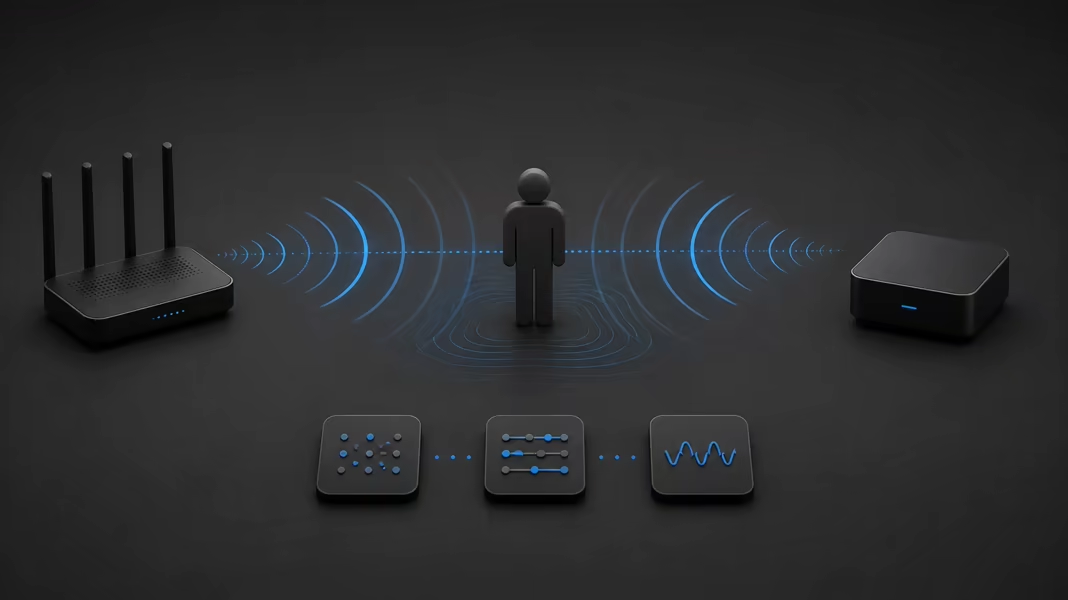
Wi-Fi radios already measure how the signal changes between sender and receiver, so they can communicate reliably. IEEE 802.11bf lets devices coordinate these measurements for sensing.
ESPectre uses the CSI from today's ESP32 chips to build and test everything above the measurements: algorithms, runtime, events, and integrations. That work is useful now, and carries over once small 802.11bf chips offer a documented sensing API.
From communication to sensing
A Wi-Fi receiver sees more than the data a router sends. It also sees how the signal traveled: walls, furniture, and moving people all change its paths. Channel State Information, or CSI, captures part of that across the Wi-Fi subcarriers.
Most Wi-Fi devices use these measurements only to communicate better. Sensing asks a different question: what do changes in them say about the distance, speed, direction, or movement of things in a room?
That is the idea behind Wi-Fi sensing: the network no longer just carries data, the radio signal itself becomes useful information.
What IEEE 802.11bf changes
IEEE 802.11bf-2025, published in September 2025, is an amendment to the Wi-Fi standard for sensing. It covers the license-free bands between 1 and 7.125 GHz, and above 45 GHz.
The main change is coordination. According to the IEEE 802.11 WLAN Sensing Task Group, devices can:
- Announce what sensing they support.
- Ask for and set up the transmissions used to take sensing measurements.
- Share the measurement results.
Today's ESP32 sensing, instead, relies on ordinary network traffic and on the data the chip happens to provide.
A standard for measurements, not meaning
IEEE 802.11bf does not define a motion detector, a presence detector, or an activity classifier. It only standardizes how devices take and share measurements. Turning those into reliable results is still a job for signal processing, machine learning, and testing.
It also does not mean that every new Wi-Fi device will support sensing, that every chip will offer the same API, or that today's CSI algorithms will work unchanged. Devices will still differ in antennas, bandwidth, timing, data format, and calibration.
Where an 802.11bf backend fits
| Layer | ESPectre today | Standards-backed direction |
|---|---|---|
| Measurements | CSI from supported ESP32 chips, using ordinary Wi-Fi traffic | Measurements taken on purpose through the standard's sensing procedures |
| Platform boundary | ESP-IDF's CSI API on current ESP32 chips | A chip and driver that expose 802.11bf, or similar documented sensing data |
| Sensing logic | ESPectre's features, detectors, calibration, and events | The same events and protocol where possible, with algorithms retested or adapted |
| Status | Working and tested on supported hardware | The software is ready for it; work starts when suitable hardware offers documented measurements |
This separation already exists in the firmware. A new measurement source plugs in below the runtime, and events, protocol, and integrations can stay the same where the new measurements allow it.
Being ready in the design does not mean it is supported. A real 802.11bf source still needs documented hardware access, new datasets, detector testing, and resource measurements first.
What has to happen next
Small chips must support it
The standard is published. ESPectre still needs affordable hardware that supports it.
Drivers must offer a stable API
A feature hidden in closed firmware is no use to an open project. Developers need documented access to the measurements, their timing, and their errors.
Algorithms must be retested on the new measurements
Better coordination may give more consistent data, but today's detectors will not automatically work as well on it.
Products must be open about sensing
Wi-Fi sensing uses no images or audio, but presence and movement data can still reveal daily habits. People need to know when sensing is on, agree to it, and trust that the data is protected.
What ESPectre can do now
Today's ESP32 chips are enough to build open algorithms, run repeatable tests, and add local motion detection to real products. This work also shows the limits of today's CSI: it depends on traffic, each vendor exposes it differently, and it was never designed for sensing.
Standard measurements could make research more repeatable and devices better coordinated, but that has to be proven on real hardware.
On the ESPectre roadmap, IEEE 802.11bf support starts as soon as suitable hardware gives documented access to these measurements.